 Canvas
ObjectQuel ORM
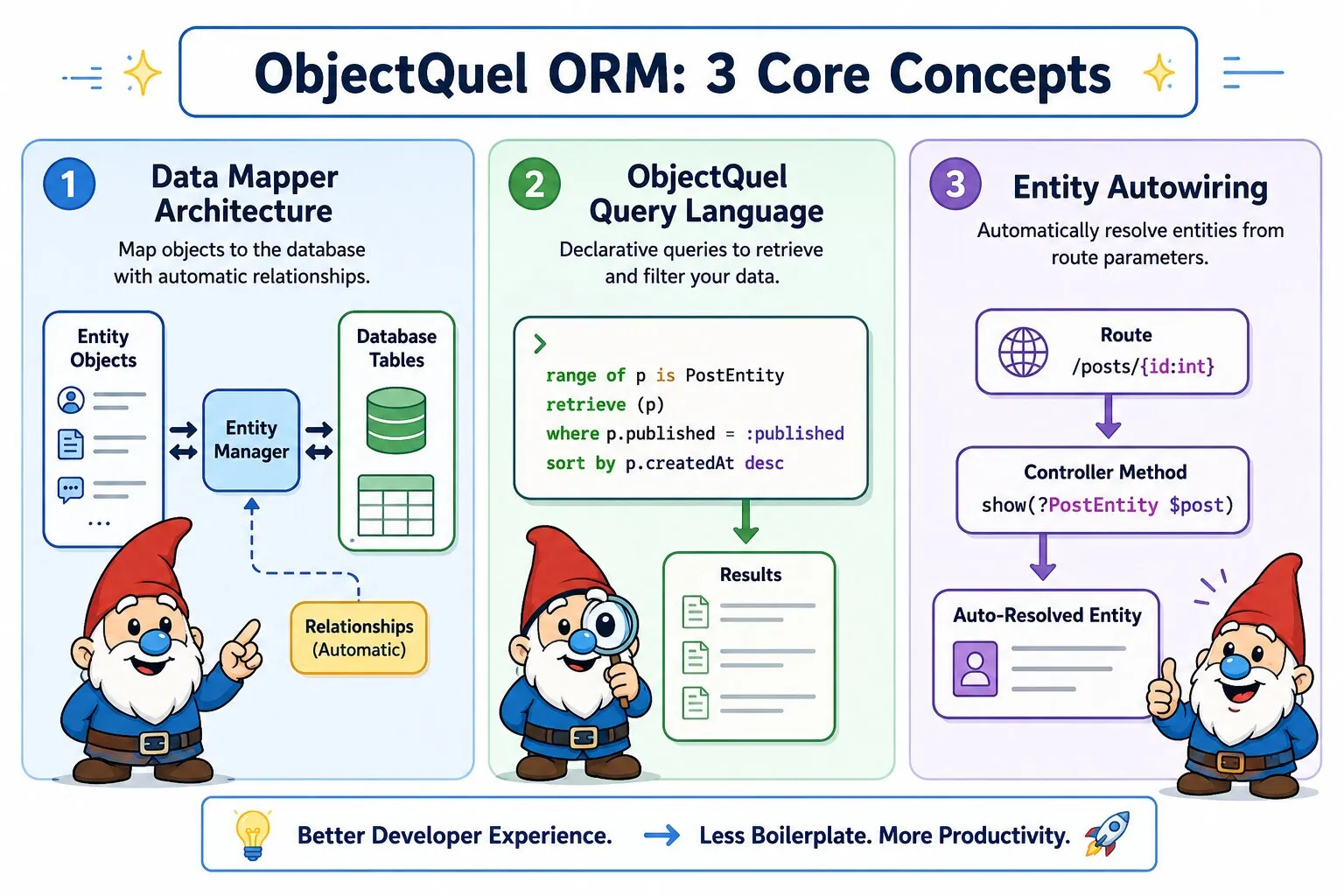
ObjectQuel ORM provides an intuitive object-relational mapping layer with a purpose-built query language, automatic relationship management, and Data Mapper pattern architecture.
Installation
Install ObjectQuel in your Canvas project via Composer:
composer require quellabs/canvas-objectquelConfigure your database connection in config/database.php:
return [
    'driver'           => 'mysql',
    'host'             => 'localhost',
    'database'         => 'database',
    'username'         => 'root',
    'password'         => '',
    'port'             => 3306,
    'charset'          => 'utf8mb4',
    'collation'        => 'utf8mb4_unicode_ci',

    // Development mode
    'development_mode' => true,

    // Entity namespace
    'entity_namespace' => 'App\\Entities',

    // Path to the entities folder
    'entity_path'      => dirname(__FILE__) . '/../src/Entities/',

    // Path to the proxy folder
    'proxy_path'       => dirname(__FILE__) . '/../storage/objectquel/proxies/',

    // Path to the migrations folder
    'migrations_path'  => dirname(__FILE__) . '/../migrations',
];
Once installed and configured, ObjectQuel is automatically discovered by Canvas. The EntityManager becomes available via $this->em() in controllers that extend BaseController.
CLI Tools (Sculpt)
ObjectQuel includes Sculpt, a CLI tool for development tasks:
# Create new entity interactively
php vendor/bin/sculpt make:entity

# Generate entity from existing table
php vendor/bin/sculpt make:entity-from-table

# Generate and run migrations
php vendor/bin/sculpt make:migrations
php vendor/bin/sculpt quel:migrate

# Rollback migrations
php vendor/bin/sculpt quel:migrate --rollback
Entity Definition
Define entities using PHP annotations:
/**
 * @Orm\Table(name="users")
 */
class UserEntity {
    /**
     * @Orm\Column(name="id", type="integer", length=11, primary_key=true)
     * @Orm\PrimaryKeyStrategy(strategy="identity")
     */
    private ?int $id = null;

    /**
     * @Orm\Column(name="name", type="string", length=255)
     */
    private string $name;

    /**
     * @Orm\Column(name="email", type="string", length=255)
     */
    private string $email;

    /**
     * @Orm\Column(name="created_at", type="datetime", nullable=true)
     */
    private ?\DateTime $createdAt = null;

    // Standard getters and setters
    public function getId(): ?int { return $this->id; }
    public function getName(): string { return $this->name; }
    public function setName(string $name): void { $this->name = $name; }
    // ...
}
Basic CRUD Operations
Standard find, persist, and remove operations:
// Find by ID
$user = $this->em()->find(UserEntity::class, $id);

// Find by criteria
$admins = $this->em()->findBy(UserEntity::class, [
    'active' => true,
    'role' => 'admin'
]);

// Create
$user = new UserEntity();
$user->setName('John Doe');
$user->setEmail('john@example.com');
$this->em()->persist($user);
$this->em()->flush();

// Update
$user->setEmail('newemail@example.com');
$this->em()->persist($user);
$this->em()->flush();

// Delete
$this->em()->remove($user);
$this->em()->flush();
ObjectQuel Query Language
Execute queries using ObjectQuel's declarative syntax:
// Basic query
$results = $this->em()->executeQuery("
    range of p is App\\Entity\\PostEntity
    retrieve (p) where p.published = :published
    sort by p.createdAt desc
", [
    'published' => true
]);

$posts = array_column($results, 'p');

// Query with relationships
$results = $this->em()->executeQuery("
    range of u is App\\Entity\\UserEntity
    range of p is App\\Entity\\PostEntity via u.posts
    retrieve (u, p) where u.id = :userId
    sort by p.createdAt desc
", [
    'userId' => $authorId
]);
Entity Autowiring
Canvas automatically resolves entity parameters in controller methods. Type-hint an entity class and Canvas fetches it from the database using the route's primary key — no manual lookup required.
/**
 * @Route("/posts/{id:int}")
 * @param PostEntity|null $post
 * @return Response
 */
public function show(?PostEntity $post): Response {
    if (!$post) {
        return $this->notFound('Post does not exist.');
    }

    return $this->render('blog/show.tpl', ['post' => $post]);
}
By convention, Canvas matches the {id} route parameter to the entity's primary key. The parameter is nullable — if no record is found, null is passed and you handle it in the controller.
Non-standard route parameters
When the route parameter is not named id, use the @ResolveEntity annotation to specify which route parameter holds the primary key. Pass the entity class using ::class syntax as the first argument:
/**
 * @Route("/posts/{slug:string}")
 * @ResolveEntity(PostEntity::class, routeParam="slug")
 * @param PostEntity|null $post
 * @return Response
 */
public function show(?PostEntity $post): Response {
    if (!$post) {
        return $this->notFound('Post does not exist.');
    }

    return $this->render('blog/show.tpl', ['post' => $post]);
}
Multiple entity parameters
When a method has more than one entity parameter, add a @ResolveEntity for each. The entity class identifies which parameter each annotation applies to:
/**
 * @Route("/users/{userId:int}/posts/{postId:int}")
 * @ResolveEntity(UserEntity::class, routeParam="userId")
 * @ResolveEntity(PostEntity::class, routeParam="postId")
 * @param UserEntity|null $user
 * @param PostEntity|null $post
 * @return Response
 */
public function show(?UserEntity $user, ?PostEntity $post): Response {
    if (!$user || !$post) {
        return $this->notFound();
    }

    return $this->render('blog/show.tpl', ['user' => $user, 'post' => $post]);
}
@ResolveEntity reference
| Parameter | Required | Description |
|---|---|---|
First argument |
When using multiple entity parameters or a non-standard route parameter | The entity class to resolve, using ClassName::class syntax. Refactor-safe — your IDE will update it automatically on rename. |
routeParam |
When route parameter is not named id |
The name of the route placeholder that contains the primary key value. Defaults to id. |
Repository Autowiring
Repositories can be injected directly into any constructor or controller method that Canvas resolves. When Canvas encounters a repository as a parameter type, it resolves it through the DefaultServiceProvider, which instantiates it once and reuses that instance for the lifetime of the application.
class OrderController {
    public function __construct(
        private readonly OrderRepository $orders,
    ) {}
}
No manual instantiation or container configuration is needed — declaring the type is sufficient.
Learn More
For comprehensive documentation on ObjectQuel including advanced query syntax, caching strategies, transaction management, and performance optimization, visit the ObjectQuel documentation site.